
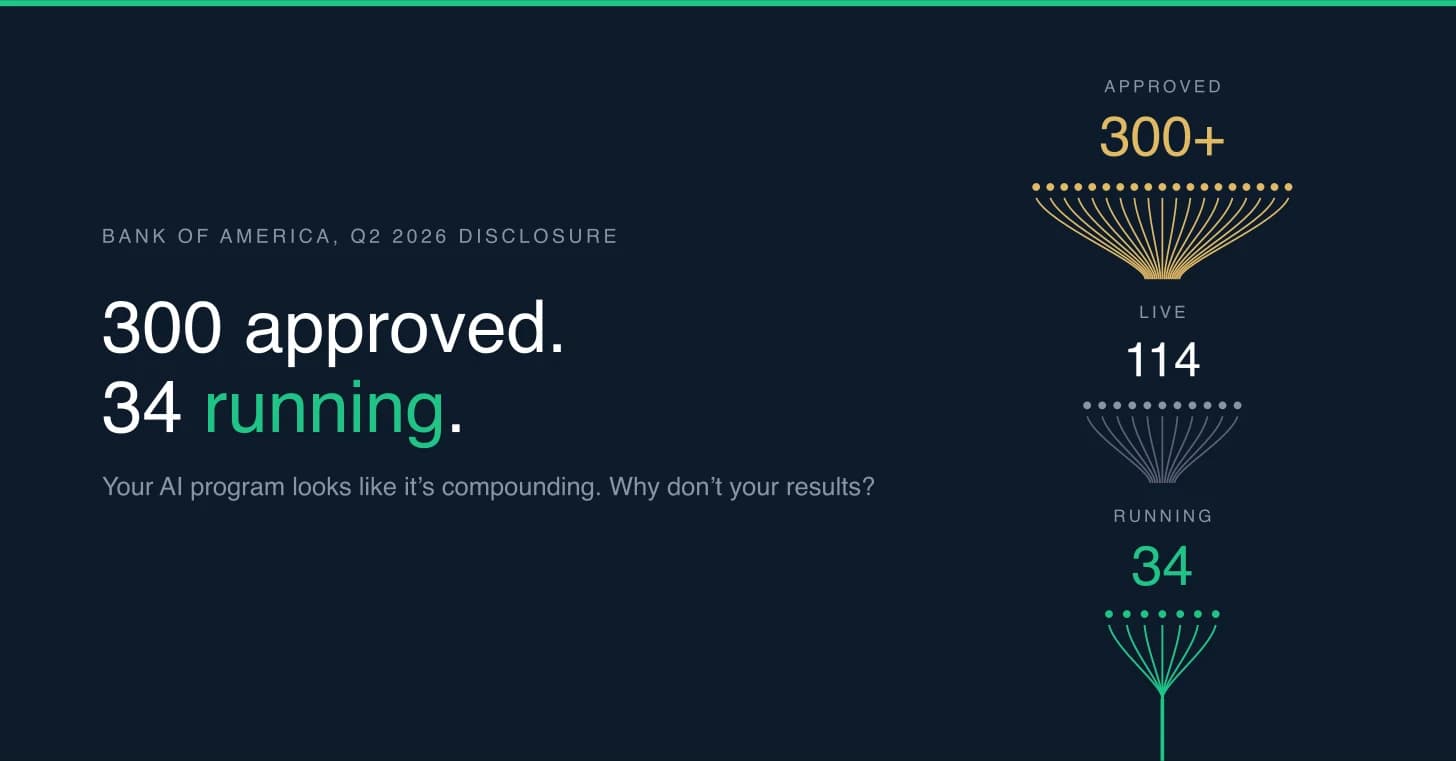
Your AI program looks like it is compounding. Your results do not show it.
That gap is the defining executive problem of this year, and the usual explanations do not survive contact with the evidence. It is not that the technology underdelivers. It is not that your people are resisting. It is that the thing being counted and the thing that produces a result are two different objects, and almost every internal report conflates them.
The clearest statement of why came from someone with every incentive to say the opposite.
On 14 July, on JPMorgan Chase's second-quarter earnings call, Jamie Dimon counted nearly 1,000 live AI use cases across risk, fraud, marketing and document reading, according to reporting from the call. Then he said AI is expensive, and that he does not expect it to lift the bank's margins any time soon as usage scales. Then this:
"You don't uniquely benefit from AI. The ultimate beneficiary of AI will be our customers."
The executive running one of the largest AI programs in financial services told shareholders the technology is a cost of staying in business rather than a source of margin.
I would push it one step further than the usual commoditization shrug. If the model is the same model your competitor rents, the model is not the asset. Everything you own sits in the distance between a thing that works once and a thing that works every night. That distance is where the budget goes, and it is the only place advantage can accumulate.
Two days of bank earnings later, somebody published the size of it.
The second number almost nobody reports
Bank of America put the entire funnel on one slide in its second-quarter investor presentation, in a single line worth reading twice.
">300 AI / machine learning use cases approved | 114 live generative AI use cases with 34 fully deployed"
Read it left to right. More than three hundred approved. One hundred and fourteen live. Thirty-four fully deployed.
Three numbers, three completely different things, and only the last one is doing any work.
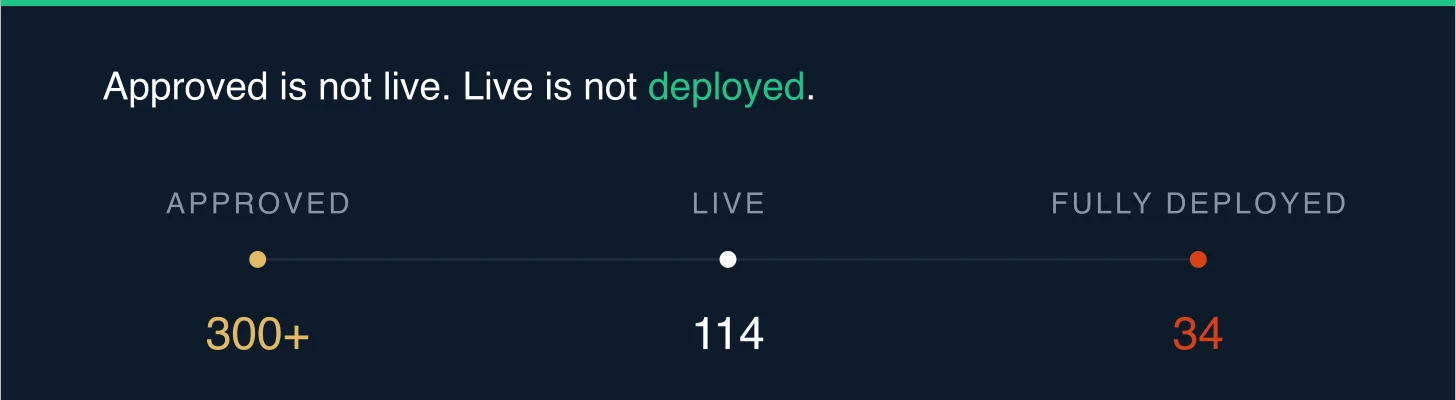
Thirty-four against more than three hundred approved is roughly one in nine. Against the hundred and fourteen already live it is closer to one in three. Both ratios come off the same line, and the company published both rather than choosing the flattering one.
That is a serious operator running a serious program, and the only reason anyone can do this arithmetic is that Bank of America disclosed all three stages. Most companies publish the first number and call it a program.
The two numbers describe completely different things.
Approval is a decision. Running is a build.
An approval means a committee looked at a demo, liked it, and cleared a path. A running use case has survived the bad input, the missing field, the vendor who changed a template without telling anyone, the month-end when volume triples, and the auditor who asks why it did what it did in April. One of those is a meeting. The other is engineering.
Your AI pipeline report almost certainly counts the meetings.
What a demo measures
Put it in your own operation. You have a process an agent handles beautifully in a demo. It reads the file, matches the records, explains the breaks in plain language, and everyone in the room nods.
Now put it in production. The file arrives late on a Tuesday. A field comes through blank. Someone posts a manual entry at 11pm that changes a balance the agent already matched.
The agent still produces an answer. They always produce an answer.
Would anyone have caught it if the answer was wrong?
That is the difference between approved and running, in the only place it matters. Approved means it worked on the day you watched. Running means it works on the day nobody is watching, and you can show afterward what it did and why.
I have sat in those rooms and nodded at plenty of demos. Nothing dishonest happens in one. A demo measures one run. The business measures every run.

Somebody published the invoice
On 30 July, WTW gave investors something rarer than a demo. It gave them a price.
The company launched Propel, a plan to embed AI and automation across its operations by the end of 2028. The disclosed figures are approximately $625 million in cash, plus approximately $25 million in non-cash charges, to produce approximately $400 million in annual run-rate savings. After roughly $50 million of reinvestment, about $350 million net.
That is the whole argument in one line item, and WTW does the division for you. The release states a cash-cost-to-achieve ratio of approximately 1.6 times. Roughly 1.6 dollars of cash going out for every dollar of annual savings coming in, before anything has been saved, disclosed by the company rather than inferred by me. You can run the same division on your own business case in about ten seconds.
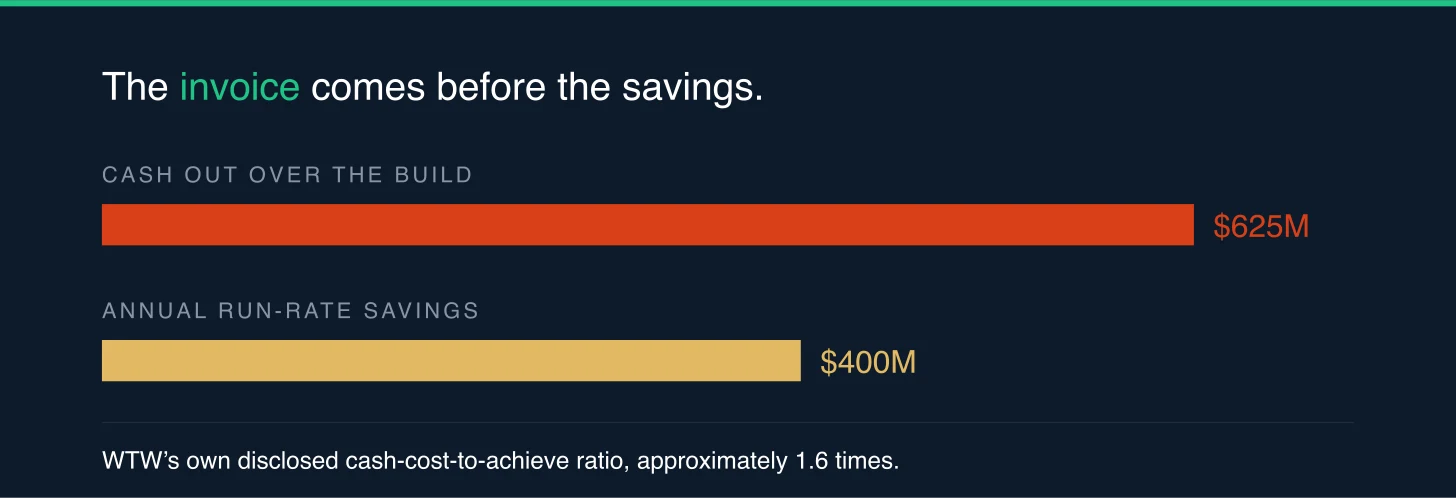
Nobody spends $625 million on model access. Model access is a rounding error inside that number. What you are looking at is the price of closing the distance between approved and running, once, at one firm, over three years. Integration. Data that is wrong in a hundred small ways. Controls. Testing. The rework when the first version quietly breaks something downstream.
That is also the honest reading of why Dimon does not expect margin expansion soon. It is not that the technology fails to work. It is that the working part is cheap and available to everybody, and the part that turns it into a process is neither.
What changes if you accept this
How you allocate. Model selection stops being a strategic decision and becomes procurement. The strategic decision is which processes you are willing to fund all the way to running, knowing the ratio, and how few that means this year. A portfolio of 300 approvals is not ambition. It is a queue nobody has priced.
How you report. Change the metric on the slide from AI use cases approved to in production, running unattended, reconciled. Bank of America's disclosure separates those categories. Most internal reporting does not, which is how a program can look like it is compounding while the same eight things carry all of it. If the second number embarrasses you, the number is doing its job.
What you underwrite. Ask for the ratio before you approve. Cash out over the build, against annual run-rate savings in, both in dollars. If nobody can produce it, what is in front of you is a demo with a budget attached.
Where the durable asset sits. The model is the commodity. The rule the model runs inside is the asset. If the logic that decides whether something matches, or whether a variance is material, lives in a prompt somebody tunes, you own nothing that survives the next model swap and you cannot show anyone why April looked different from May. Write it as an explicit rule you can read, test, version and point at.
The gap is not a finance problem
It is worth saying plainly, because the examples above come from banks. Nothing in this argument belongs to finance.
A sales organization counts AI-assisted opportunities and reports adoption. The question is how many quotes were produced, priced and approved end to end without someone rebuilding them in a spreadsheet. A service organization counts deflected tickets. The question is how many were resolved without a second contact. A procurement team counts requisitions touched. The question is how many reached a purchase order under a rule somebody wrote down.
In every case the reported number describes participation and the useful number describes completion. They diverge in the same direction and by roughly the same magnitude, and the divergence is invisible unless someone insists on counting the second one.
That is also why this cannot be delegated to the function that owns the tool. The person who bought the software is the wrong person to ask how much of it finished.
Where to test it
Pick the most demoed process you own. In most companies that is invoice matching, because it has the cleanest before-and-after story and the exceptions are already counted, which makes the distance between approved and running easy to measure.
Then ask something narrow. Of the items the agent handled last month, how many completed without a person touching them, and could you show an auditor the rule that decided each one?
If the first half is a big number and the second half is a shrug, you have an approval rather than a process. That is fixable. It is not fixable while the pipeline report insists it is already done.
The uncomfortable part of Dimon's point is not that the model gives you no edge. It is the corollary. Everything that does give you an edge sits in the unglamorous middle, and it costs $625 million at WTW's scale because it is engineering rather than a purchase. Which means the companies that pull ahead will not be the ones that approved the most. They will be the ones that finished the fewest things properly and can prove it.
So the next time somebody puts an AI number in front of you, ask which kind it is.
How many of your AI use cases ran last night without anybody watching?
Sources
JPMorgan Chase, live AI use cases and the cost of AI, July 2026, via earnings-call reporting.
Bank of America, AI use cases approved against fully deployed, July 2026.
WTW, Propel run-rate savings and cost to achieve, July 2026.