
"Yes, you can take a cut of your worker's tips."
That was New York City's official small business chatbot, in early 2024. That is illegal in New York.
The same bot said a restaurant could go cash-free, which the city had banned in 2020. Asked whether landlords have to accept tenants with housing vouchers, it said no. Ten people at The Markup asked separately. It told all ten of them no. That is also illegal.
The page said the bot was "trained to provide you official NYC Business information."
The city added a disclaimer and left it running for almost two more years.
The bot was doing what language models do, producing a plausible answer to whatever it's asked. Nobody decided what should happen when the plausible answer was wrong.
The Question Nobody Writes Down
Every company deploying AI is making a version of this decision, usually without naming it. The model reads the documents, interprets the conversation, produces an answer. What almost nobody writes down is whether that answer gets to be the decision.
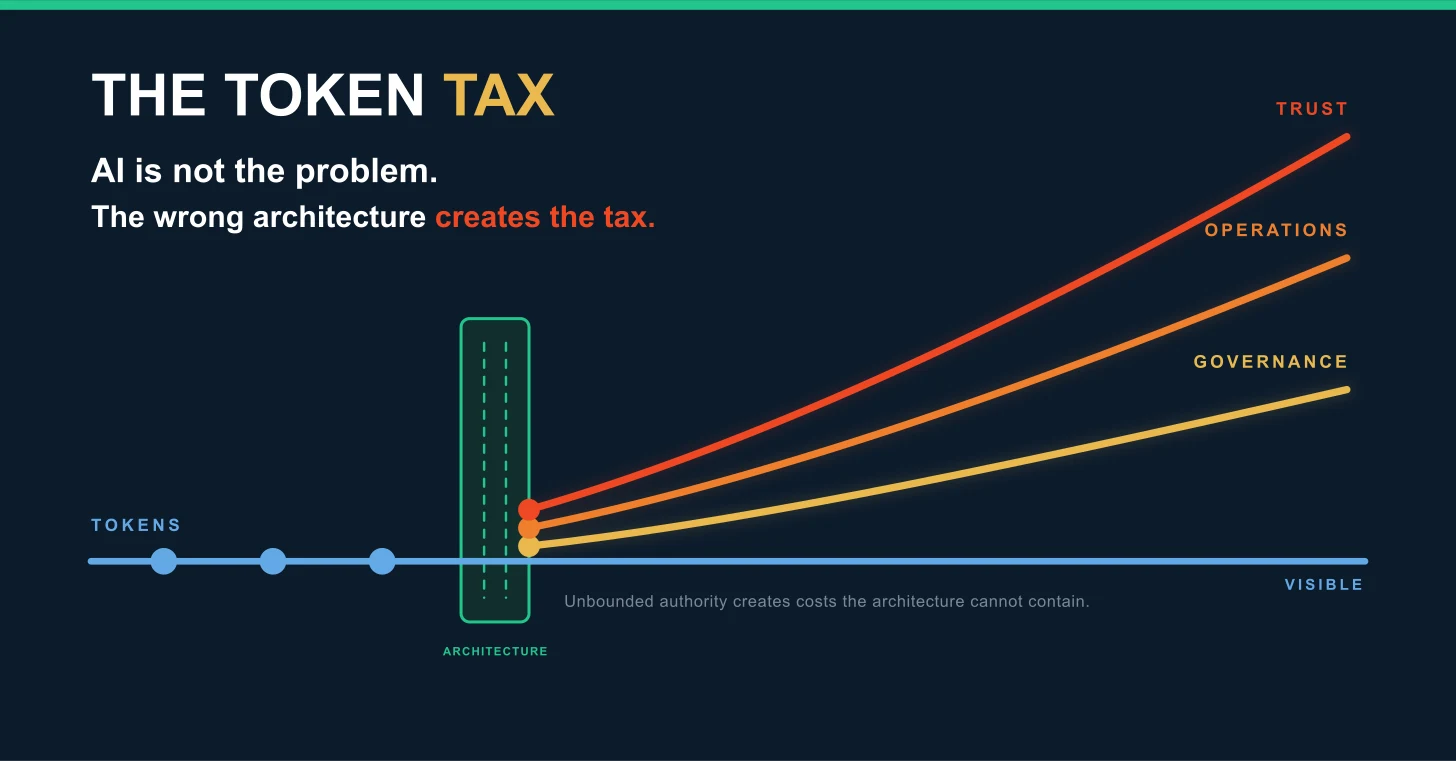
The distance between what AI can do and what it should be allowed to own is the Authority Gap. What you pay for crossing it without boundaries is the Token Tax.
Tokens are the visible part, the units consumed whenever a model processes or generates information. They are also the only part that arrives on an invoice. The governance, operational and trust costs never show up as a line item at all.
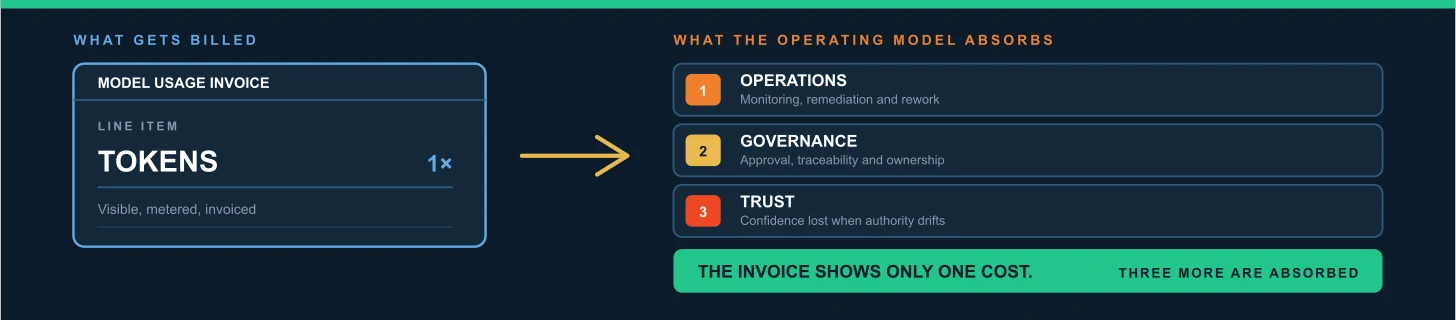
This isn't your ordinary cost of using AI where judgment creates value, and it doesn't mean AI should never act on its own. The tax arrives when the scope of that action, its escalation path and its accountable owner are undefined.
To see where it comes from, separate any AI-enabled process into three layers.
Intelligence. What is happening. AI interprets information, recognizes patterns and generates recommendations. This is where probabilistic systems earn their keep, working with uncertainty instead of requiring every case to be specified in advance.
Authority. What is allowed to happen. Business rules, permissions, approvals, policies and accountable ownership. This determines who, or what, may turn an interpretation into a business commitment.
Execution. How the authorized action happens reliably. Consistency, auditability, traceability and control. It turns a decision into action while preserving evidence of what happened and why.
Most companies collapse all three into one and assume that if AI understands the situation, it should decide the outcome.
The Firm That Had Every Reason to Go Further
Morgan Stanley had more license to push than New York City did.
It was the first major Wall Street firm to put a bespoke GPT-4 tool in its employees' hands, with early access to the strongest models available and a research library of about 100,000 documents to point them at.
Morgan Stanley built two tools. Neither talks to a client.
The Assistant retrieves information from approved internal content for advisors. Debrief, with client consent, takes notes in client meetings, surfaces action items and drafts the follow-up email. Then it stops. Every draft goes to an advisor who reads it, edits it and decides whether it gets sent.
As of June 2024 the firm reported that 98% of advisor teams had adopted the Assistant. One of them, Don Whitehead, said Debrief saved him about half an hour per meeting on notetaking alone. Company-reported numbers, two years old, not an independent study. The pattern still holds. Boundaries didn't stop the system from becoming useful.
Morgan Stanley bought the most capable AI it could get and pointed it at the advisor rather than the client. The difference with MyCity isn't government versus finance. It is where the authority sits. MyCity's sat with a chatbot. Morgan Stanley's sits with the person who signs the email.
Authority Gets Borrowed
In New York, nobody ever put it anywhere. That is the part of the story easiest to miss.
MyCity never had execution authority. It couldn't issue a permit, file a form or move a dollar. It only answered questions.
So nobody handed AI the power to act. Nobody handed it anything. Put a language model behind a government's logo, tell users it's trained on official information, and it acquires the institution's authority without a single person deciding to grant it.
Borrowed authority is harder to govern than the granted kind, because there's no approval to point to afterward.
Two years later a comptroller audit found the bot still giving different answers to identical questions. Of the users who bothered to rate it, 71.4% were dissatisfied. The city was still reporting accuracy above 95%.
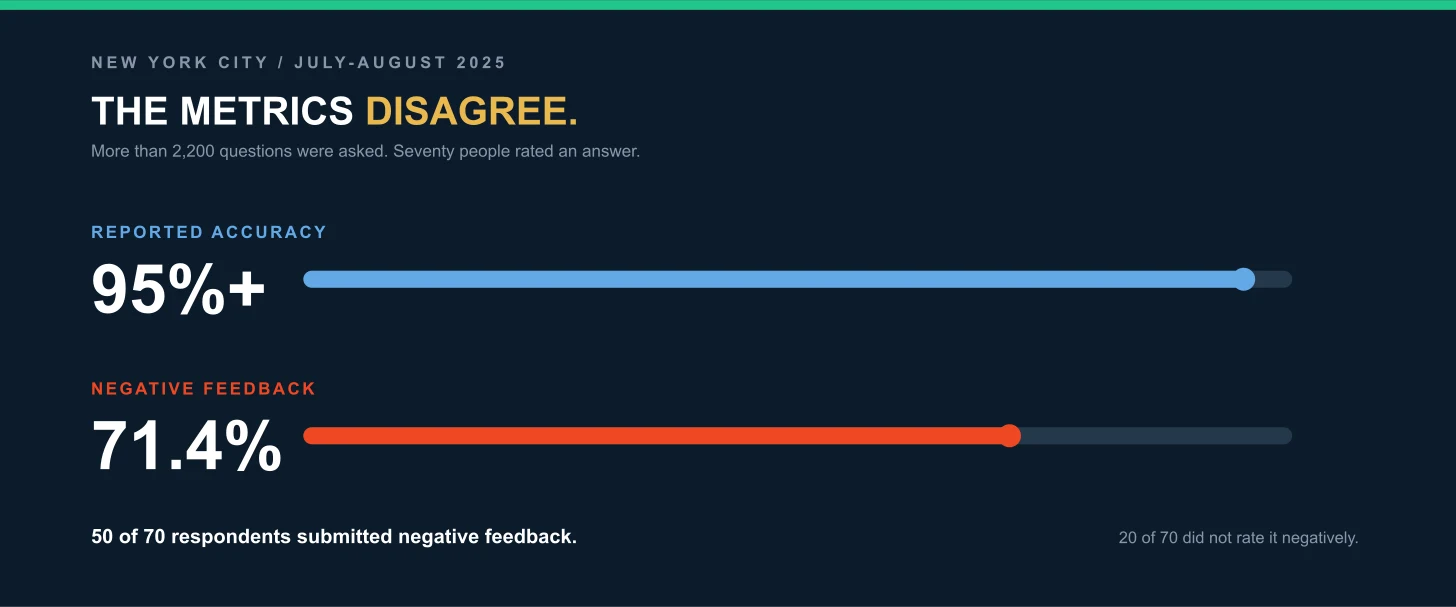
The failure wasn't that generative AI produced uncertain answers. The failure was letting uncertain answers borrow the authority of government.
The Four Costs
The Token Tax rarely arrives as one dramatic failure. It compounds. Variable outputs require review, review creates workflows, workflows obscure ownership, unclear ownership slows everything behind it.
Financial. You pay for model reasoning where a validated rule would do, then pay again for review, remediation and rework.
Operational. You add monitoring, testing and exception handling to manage variability you created by putting AI in a role that never required interpretation.
Governance. A recommendation becomes an action, an action becomes a commitment, and ownership becomes hard to locate. Approval evidence comes back incomplete and auditors cannot reconstruct what happened.
Trust. Employees hesitate to rely on systems they cannot understand. Customers distrust systems that cannot explain themselves. Executives refuse to scale systems they cannot control.
Notice what all four have in common.
None of them is a cost of intelligence. Every one is a cost of authority.
Authority Is Not the Enemy
None of this argues that AI should interpret and never act. I use AI regularly to do both. Plenty of actions can be delegated safely, including routing a request, retrieving an approved record, preparing a draft or clearing a routine transaction inside defined limits.
The question isn't whether AI acts. It is whether its decision rights match the consequences. A service agent might issue a refund below a threshold and escalate everything above it. A finance agent might assemble a payment package while release authority stays with an accountable approver. Autonomy can widen as reliability is demonstrated, as long as the limits stay explicit.
That is bounded authority. The system acts inside a defined envelope, and policy, permissions, monitoring and escalation determine where the envelope ends.
Watch the Envelope End
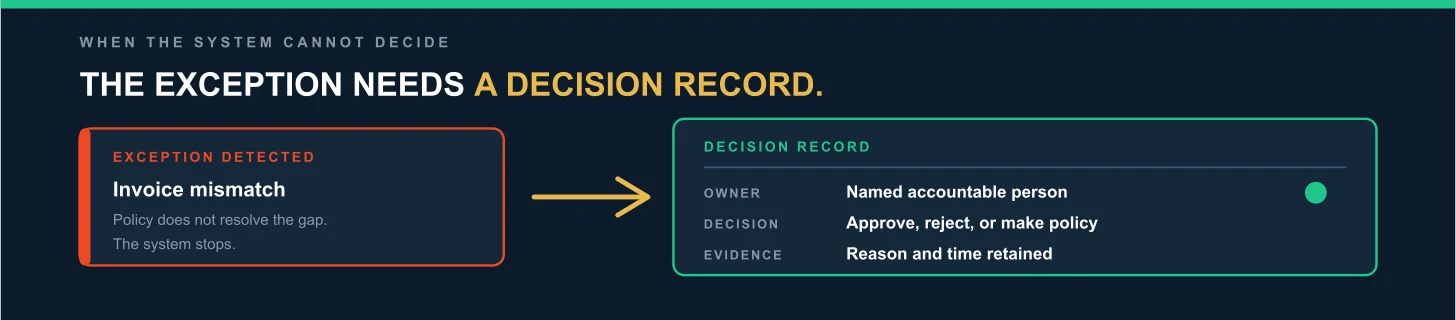
An invoice arrives and doesn't match the purchase order. The amounts are close but not equal, and the tolerance policy doesn't obviously cover the gap.
A theatrical system improvises. It picks the most plausible reading and posts.
A bounded system pauses. It says what it found, what it can't resolve, and what it needs. The question goes to the person who owns that tolerance, not to whoever happens to be nearest. They answer. The invoice posts.
Then the part that matters. That answer can stay a one-time exception, become guidance the system applies to that process from now on, or become policy. Somebody decides which, and that decision is visible, attributable and reviewable later.
The exception is where authority stops being a diagram and becomes a name.
The Objection Worth Taking Seriously
If a licensed professional reads every draft, what did you actually automate?
Fair question. The honest answer is that you automated the slow part, not the risky part. Reading a summary is faster than writing one. Checking a figure is faster than hunting for it. Morgan Stanley's 98% is an adoption number, not a productivity number, and adoption is easier to report than throughput.
The review bottleneck is real. It is also the price of being able to say who decided.
Skip it and you don't avoid the cost. You pay it later, in remediation instead of minutes.
The AI Monolith
Enterprise software already learned that packing too many responsibilities into one tightly coupled application creates fragility. Changes get harder to test, failures harder to isolate, ownership harder to define.
An AI monolith isn't simply one large model. It is a system allowed to interpret, reach resources, decide and execute with no boundaries between those responsibilities. The trap springs when permissions, controls, escalation conditions and failure boundaries are not separated from one another.
The best AI architectures have visible seams. Nobody scales what they can't take apart. Seamless is what a monolith calls itself.
You Have Probably Already Crossed It
Most organizations reading this have crossed the line somewhere. Not dramatically. A summarizer that started drafting the customer response. A classifier that began routing without review.
Last month a controller joined our working session to ask who would hold the write permission. Not what the model could do. The last platform they piloted was read-only, she said. On paper. The downstream integration still had posting rights. Then four invoices posted that nobody had approved. She didn't come to ask whether AI works. She came to ask who decides, at what point, and whether anyone could tell afterward.
Before assigning AI a role in any business process, ask:
Necessity. Does this step genuinely require interpretation, or would a validated rule be sufficient?
Authority. Who turns the output into a business commitment?
Scope. What may the system do independently, and what conditions require escalation?
Controls. Which permissions constrain those actions?
Evidence. What must be retained so the decision can be explained later?
Failure. What happens when confidence is low, information conflicts, or the system fails?
If the answers are unclear, you aren't ready to give the system more responsibility. More autonomy will not resolve an undefined authority model. It only changes how late you find out.
What It Costs to Find Out Later
In February 2026 the MyCity chatbot's page went dark. The notice said the beta test had ended. Not that the answers had been wrong. That the test was over. The program around it had spent $100 million.
Nobody ever decided that chatbot should carry the authority of the city. That is exactly how it got it.
The same thing is happening inside your company right now, in smaller ways. The fix is not less AI. It is deciding, on purpose and in writing, what your systems are allowed to own.
Sources
The Markup, the NYC chatbot's wrong answers, March 2024.
Office of the New York City Comptroller, MyCity user feedback against reported accuracy, December 2025.
The Markup, the chatbot's discontinuation, January 2026.
Morgan Stanley Wealth Management, adoption of the AI Assistant, June 2024.
CNBC, the research library behind the Assistant, September 2023.
OpenAI, the Morgan Stanley case study.