
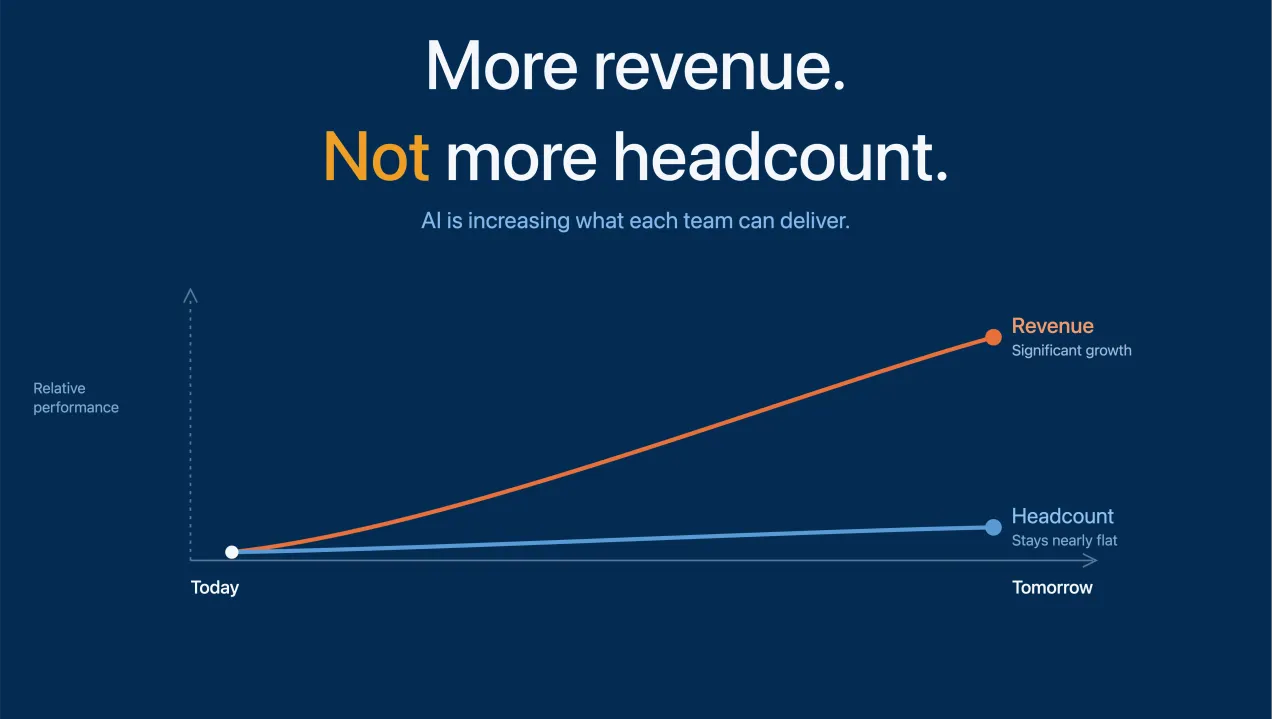
For as long as I’ve been in this industry, channel economics have run on one simple, reliable equation. Grow revenue, and headcount followed right behind it. More customers meant more consultants. More projects meant more engineers. It’s worked for decades, and there’s nothing wrong with a model that works.
I think that’s starting to change.
Omdia is projecting channel partners will do more than $4 trillion in global value in 2026, with partner-delivered revenue up 6.7% year over year. Big number, and it's still climbing. But the partners who win the next five years won't be the ones who grew headcount fastest. They'll be the ones who figured out how to grow without dragging a bigger cost base behind them.
That’s the part nobody’s pricing in yet.
Why the old model worked (and why it’s cracking)
The labor-scaling model made sense when transformation work was unavoidably manual. Somebody had to sit down and map the workflow, write the integration, work through exceptions as they came up, train the users, walk the customer through go-live. All of that took expertise, and expertise took hours, and hours were the product.
AI doesn’t eliminate that work. It compresses it. A build that used to need a five-person team for six weeks might now need two people for two. The demand for transformation isn’t going anywhere (if anything, I’d argue it’s about to go up), but the number of humans required to deliver it per project is shrinking, and shrinking fast.
I’ve sat across the table from partner leadership teams a few times this year, and the real question is never "will our customers want this?" It's "how do we protect margin if we can't bill the same hours anymore?" Fair question, and the honest answer starts with recognizing that hourly billing was built for a world where effort and value moved in lockstep. That world is ending.
More demand, not less. Just compressed
There’s a misconception I keep running into. People assume AI shrinks the market for partners. I think it does the opposite.
When something gets cheaper and faster to deploy, people don’t do less of it. They do more of it. A company that automated one process a quarter because that’s all its budget and IT bandwidth allowed will suddenly want to automate a dozen, because the cost of trying has collapsed. So demand goes up, timelines shrink, and margin gets squeezed from both directions at once. That’s an uncomfortable place to run a business, but it’s also where the opportunity is for whoever restructures around it early.
The firms that win this aren’t the ones with the deepest bench. They’re the ones who can produce more value per person, per client, per dollar spent running the business.
Midmarket may outmaneuver the giants here
This is the part I find most interesting, and it cuts against the usual “scale wins” logic of the channel. My bet is that midsize partners are better positioned to move fast here than the big integrators.
Large SIs are carrying structural weight into this transition. Things like pricing built around utilization targets, staffing pyramids tuned to a certain junior-to-senior ratio, and delivery governance built up over a decade of enterprise contracts. None of that’s a flaw. It’s exactly what let them scale in the first place. But structure that took ten years to build doesn’t unwind in a quarter, and that gap is where a leaner partner can move.
A partner without that much architecture to unwind can rebuild its pricing and delivery model in a quarter instead of two years. I’d rather bet on speed here than on size.
The service menu is changing shape
The economics aren’t the only thing shifting. So is what partners are actually selling. Instead of hours to build and configure a system, the valuable work is shifting toward designing how fleets of automated agents behave. Things like how they hand work off, what happens when something breaks, how you prove to a compliance team that an autonomous process did what it was supposed to do, and who's accountable when it doesn't.
That’s a different skill set than traditional implementation. It leans more on judgment and architecture than on hours logged, and it’s the kind of work that’s hard to commoditize, which, not coincidentally, is exactly where the margin is going to live.
What buyers are starting to care about instead of bench size
For a long time, a big roster was the pitch. “We have 500 consultants” used to carry weight with a buyer. That's starting to share the stage with a different question. How fast, and how well, can you actually solve this?
Customers are going to care less about how big a team you can put on a problem and more about the results you deliver and how fast you deliver them. A smaller team that’s fluent in AI-driven delivery can now compete on speed and cost with a much larger traditional bench, something that would have sounded far-fetched five years ago and doesn’t anymore.
What the partners pulling ahead are already doing
There’s a pattern showing up among a handful of partners quietly getting ahead of this, and it’s worth sitting with:
They’ve got outcome-based and managed-service pricing already built, sitting alongside T&M, ready to go before a client ever asks for it. Nobody’s negotiating it from scratch under pressure.
They’re not just hiring people to build workflows. They’re building a smaller, sharper bench that knows how to design, supervise, and govern automated systems, and they’re paying those people like it matters.
Their playbooks and workflow libraries are treated as real assets, not internal documentation. A few of them are further along on reusable automation IP than plenty of software companies I’ve come across.
Headcount barely comes up in how they sell. It’s speed, risk reduction, and what stops falling through the cracks. Nobody’s buying headcount anymore, whether they say it out loud or not.
It’s a quieter shift than a rebrand or a big acquisition. But it shows up fast, once you know what to look for.
Where this leaves us
It’s entirely possible for a partner to grow revenue meaningfully over the next few years while barely growing headcount at all. Ten years ago that sentence wouldn’t have made sense. Right now it’s just what a well-run partner org looks like.
The channel’s reinvented itself before, through infrastructure, cloud, SaaS, security, and managed services. I think this shift is bigger than any of those, because it’s not just changing what partners sell. It’s changing what scale even means.
Whether AI makes delivery more efficient isn't really in question anymore. That part's settled. What’s still open is whether partners redesign pricing, talent, and delivery fast enough to keep the value they’re creating instead of watching it get commoditized out from under them. The ones that do will grow revenue without rebuilding the same cost base underneath it.
So, where does your org stand on this right now?
Sources
Omdia, channel partner value and revenue growth, January 2026, via Channel Dive.