
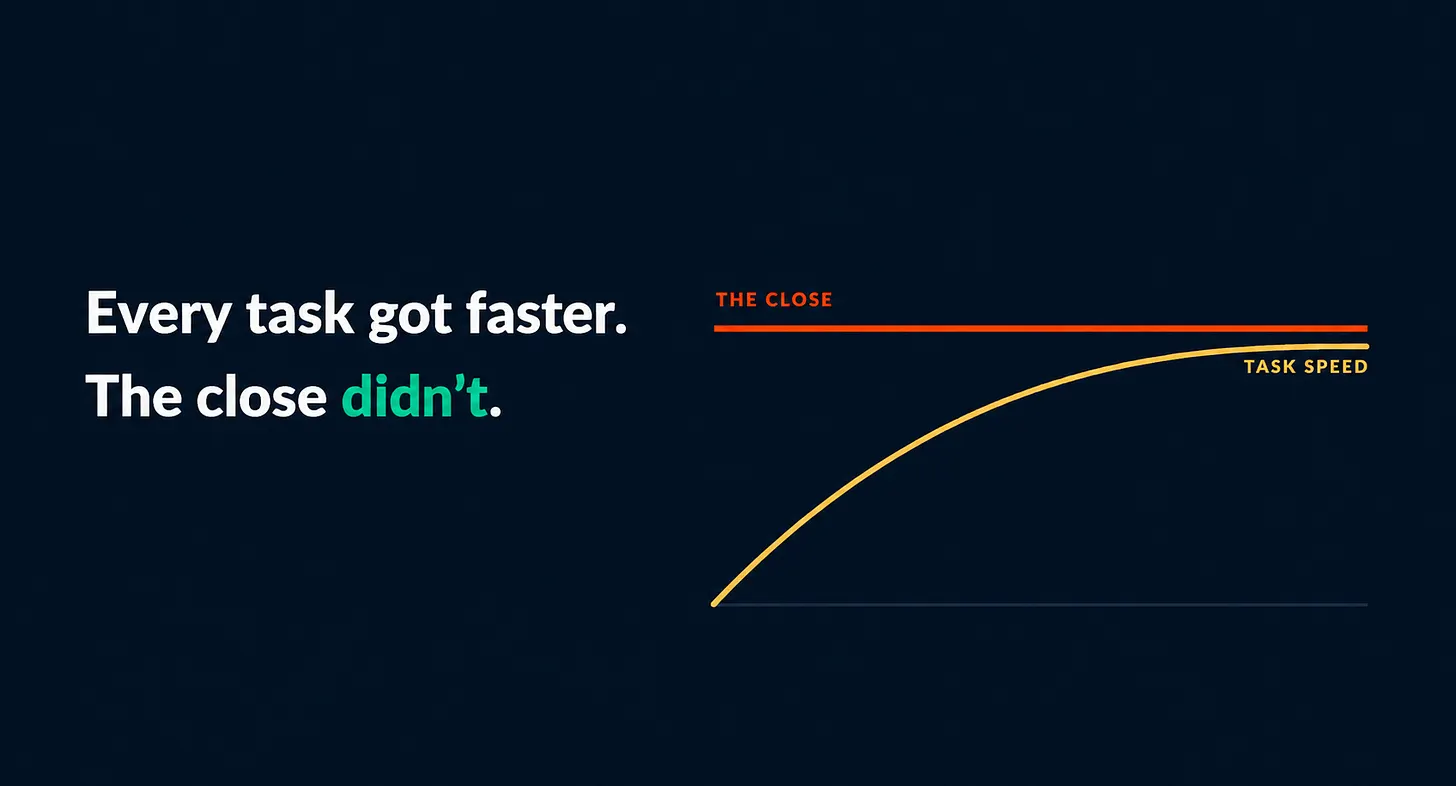
It’s day nine of the close. The board deck is due Thursday. Your team has never worked faster, and you still cannot tell anyone what the final number is.
On paper, the close should be faster. Generative AI crossed a boundary that had held for decades, suddenly interpreting information locked inside contracts, emails, invoices, purchase orders, and policy documents. Finance responded quickly. AI began drafting reconciliation explanations, flagging anomalies, writing spreadsheet formulas, and following up on missing approvals.
Nearly every task inside the month-end close became faster.
The close itself did not.
If every task got faster, why does the close still take eight days? That’s the median across more than 3,000 organizations. The benchmark measures waiting, not just working.
Because your month-end close isn’t a task. It is a sequence of work, evidence, and decisions that all have to land before anyone can trust the number. Which means the fix is not a faster assistant. It is a system that owns the sequence.
Your close isn’t one job. Call it 40 steps. Bank reconciliations, intercompany eliminations, accruals, revenue cutoff, FX revaluation, and flux analysis. Each with an owner, a handoff, and the same deadline. A number the board relies on. None of that institutional knowledge is written down anywhere the process can read. It lives in the people who’ve done it before, and when they’re out, the close waits for them too.
The breakthrough stopped at the task boundary
This isn’t a criticism of AI. It is a recognition of how significant the breakthrough has been.
The first wave of enterprise AI gave software the ability to work with meaning, ambiguity and unstructured information. That is something it had never possessed before. It explains why individual knowledge tasks are getting faster. In a Harvard Business School and BCG field experiment involving 758 consultants, those working within the model’s competence completed tasks roughly 25% faster and produced substantially higher-quality work.
But a business process is not one task. It is a sequence of tasks, decisions, permissions, system changes, exceptions and handoffs. Making each participant faster does not necessarily change the sequence.
Picture a ten-step process, knowing a real close runs plenty of things at once. Make every step 25% faster and it is still a ten-step process. It still has nine handoffs. Nine places where information can be re-keyed. Nine queues in which work can wait for someone to look up, notice and act.
Not all nine cost the same. Only the handoffs on the critical path determine the finish date. A ten-minute reconciliation blocking fifteen downstream tasks matters more than a two-hour analysis blocking nothing, and no amount of task-level speed tells you which is which.
Ask anyone who has refreshed an inbox for the tenth time in an hour. That silence is where your close actually lives.
The missing capability is not more intelligence inside each step. It’s a system that can own the work between the steps, and carry it all the way to a number you can sign.
That’s the part of the AI conversation almost nobody prepared enterprises for.
We thought the hard problem was getting AI into the workflow. The harder problem is trusting it inside the workflow. After the answer becomes an action, the action changes a system of record, and the business has to live with what happens next.
The architecture for controlled autonomy
There is an entire field built to solve this. One idea underneath it. Guessing and executing are different jobs.
Generative AI is good at the first. It reads the invoice, finds the clause, works out that two phrases mean the same thing. Deterministic logic is good at the second. It applies the tolerance, checks the approval limit, and follows the same policy on the thousandth run as on the first. Connect them with durable state, reserve human judgment for genuinely new cases, and you get neuro-symbolic AI.
The operational result is controlled autonomy.
Controlled autonomy is an operating architecture in which a system acts on its own inside a boundary the business has drawn explicitly, and stops at the edge of it.
The system can exercise judgment where it creates value without treating every policy, permission, and control as an open question.
Where is the system allowed to think, and where is it allowed to execute? Once that boundary is explicit, flexibility and control stop being a tradeoff.
Two finance teams, twelve month-end closes, two different outcomes
Two finance organizations can deploy AI in the same quarter and end up in very different places a year later. Both are still running the same forty steps.
One uses AI inside existing tasks. Its people resolve the same exceptions, reconstruct the same context, and answer the same questions before anyone will sign the number. The tools improve. The process begins each month with essentially the same operating knowledge it had before.
The other captures every approved resolution as part of the process. Each close adds supplier behavior, policy interpretations, escalation boundaries and exception logic to the system that will run the next one.
After twelve closes, these organizations do not merely have different levels of automation. They have different amounts of operational intelligence.
That difference cannot be recreated by buying the same software in month thirteen. The system has to encounter the work, involve the right people, retain what they decide and earn greater authority through visible performance.
The competitive advantage begins while humans are still involved. This is the accumulated knowledge that makes controlled autonomy possible.
What ownership actually requires
Assisting with a process and owning one are different jobs.
Ownership means holding state across steps and interruptions, applying established policy without improvising, stopping at the boundary and escalating with the context attached, and leaving a record made at the time rather than narrated afterward. The moment a person has to re-enter the result, the handoff returns.
Those aren’t features. They’re what allow a business to hand over consequential work and trust that it will be finished.
This architecture exists so a mind built for more does not spend its only career matching invoices to purchase orders. Instead, it resolves the cases that require judgment, and each resolution keeps the same question from coming back.
That’s how the next close becomes shorter than this one. And a shorter close isn’t just a finance win. It gives your team days back. A day for analysis instead of collection. A day for forecasting instead of reconciliation. A day spent deciding what happens next instead of proving what happened last month.
Why 85% accuracy per step becomes 20% accuracy end to end
An 85%-accurate model is powerful on a single messy step. But when 10 independent steps must all execute correctly in sequence without an independent check between them, those probabilities compound. Multiply 0.85 by itself 10 times and the probability of an entirely correct run drops to 19.7%.
A ten-step process built from 85%-accurate steps completes correctly about 20% of the time.
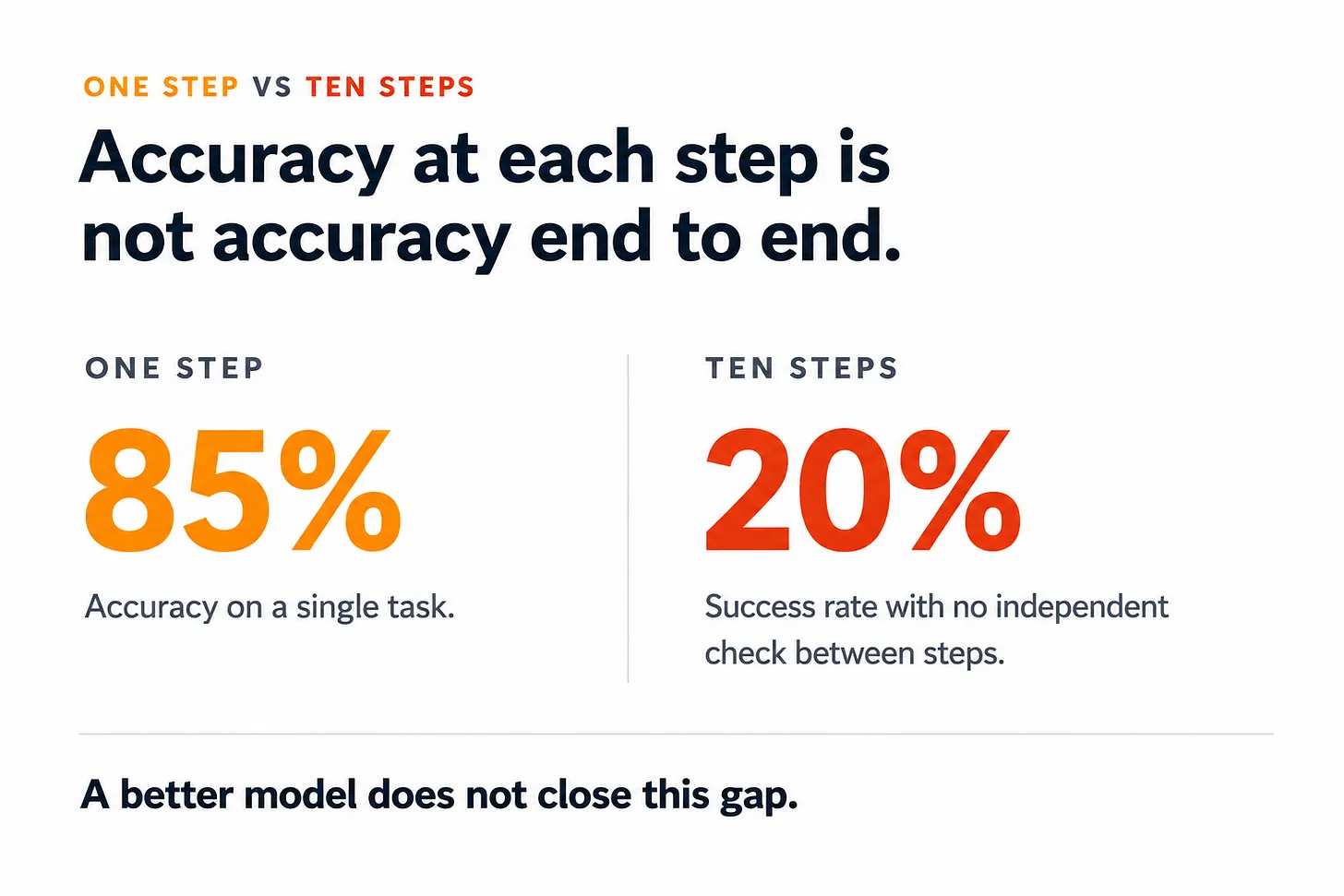
Controlled autonomy uses probabilistic AI where interpretation is required and deterministic logic wherever the business has already decided what should happen. Each action is checked against explicit rules before the process moves forward, so uncertainty cannot compound unchecked from one step to the next.
The most valuable answer is the one the system remembers
Consider an invoice from a familiar supplier. The amount is 14% above its twelve-month average, and the supplier changed its bank details eight days ago.
The generative layer reads the invoice and interprets its context. Executable business logic checks the amount, the bank update, and authority limits. The transaction falls outside approved boundaries, so the process pauses before payment.
The controller receives the invoice, the purchase order, the supplier history, the bank-change record and the exact reason for escalation. They verify the change and release the payment, but add a condition. Future bank changes for this supplier require verification through the established contact before release.
That resolution becomes approved business logic. The process resumes from the point where it paused. When the same condition appears again, the system follows the new verification rule automatically and records every step.
Resolution-guided learning turns a single approved human decision into reusable process knowledge. The human did not just correct one output. They taught the system what to do the next time it reaches that boundary. Human attention moves toward genuinely new cases instead of recurring exceptions. Pull the exception log month over month. If the rate declines, expertise is compounding inside the process. Then pull your days-to-close beside it. That’s the number you are actually judged on.
Explainable execution is different from explainable AI
Ask a modern AI system why it took an action and it will produce a fluent account of its reasoning. That account is generated after the fact. Whether it matches the computation behind the action is another matter entirely.
Auditors do not ask for a plausible story. They demand evidence. A record made at the moment: the input, the rule, the authority, the process version, the actor, and the resulting state change. That’s explainable execution, and it makes the process observable instead of asking the model to narrate itself.
A $61,000 payment comes up for release. Company policy requires two authorized approvals above $50,000. The system doesn’t ask whether both exist. It checks. If the second approval is missing, the payment doesn’t go. It doesn’t matter who’s asking.
A control that can be overridden isn’t a control. It is a policy hoping nobody tests it.
The future is already visible in production
For decades, businesses divided work into two buckets. Structured, predictable processes could be automated. Variable, judgment-heavy processes stayed with people.
The most valuable operational work sat right between them. It was too variable for rules-based automation, yet too consequential for probabilistic AI. Finance is built on this work.
Ciena, a network-hardware manufacturer, receives purchase orders in multiple languages, layouts, and document formats. Generative AI interprets each order and converts its meaning into structured business data. Executable logic then validates the fields, applies company rules, and routes the transaction. When an exception hits a boundary, the process pauses with its context preserved for a human. Once approved, that decision becomes operational logic for the next run. By combining interpretation, execution, and learning across the workflow, the company reported eliminating 98% of manual data entry. That removed the operational bottleneck, freeing teams to focus on strategic exceptions and higher-value work.
The immediate result matters, but the compounding trajectory matters more. Every new document pattern expands the work the system can reach. Every approved resolution expands the work it can complete. Every execution record strengthens the evidence for greater authority. That is how a workflow becomes operational infrastructure, and how an early implementation becomes an advantage that compounds.
How to start
Controlled autonomy does not have to begin by redesigning all 40 steps. Start with one recurring exception on the critical path, define the boundary, and turn the approved human decision into reusable process logic. Once that loop performs reliably, extend the system’s authority to the next constraint.
This is the emerging category. These systems understand operational variability without making the business’s controls variable too.
Quarter-end is where the days actually cost you
At quarter-end, the arithmetic is unforgiving. A public company files its 10-Q within 40 or 45 days, depending on filer status, and the accounting close is only the front of that process. Behind it sits management review, disclosure, internal controls, legal, and certification.
An extra close day does not push the filing deadline. It comes directly out of the time leadership has to understand the numbers before signing off on them.
The Controlled Autonomy Test
You do not need to evaluate the model to know whether an AI system can own the month-end close rather than merely assist with its tasks. Ask five questions.
State. Does it remember? Without durable state, there is no process. Only a series of tasks.
Execution. Can it complete the transaction? If a person must re-enter the result, the handoff remains.
Authority. What physically enforces the rules? Instructions describe a boundary. Executable logic enforces it.
Learning. Does each resolution improve the next run? Ask whether the same exceptions keep returning to people.
Evidence. Can it prove what happened? Look for the input, rule, authority, process version, action, and resulting state.
What actually shortens the close
The first wave made individual tasks faster. The next wave will connect that intelligence to deterministic precision, symbolic knowledge, durable state, resolution-guided learning, and proof. That will change the process.
The important divide is no longer human versus machine, or deterministic automation versus generative AI. It’s between systems that produce an answer and systems that can finish the work.
Your close is still 40 steps. Every one of them can become faster without taking a single day off the close.
The days come off when a system owns the sequence. It interprets what is ambiguous, obeys what is not, asks when it reaches a boundary, turns each resolution into durable process knowledge, and proves exactly what it did.
That’s not a better assistant.
It is controlled autonomy.
One finance organization will enter next month’s close carrying forward everything this month’s close taught it. Another will begin again with the same handoffs, the same exceptions, and the same follow-up email to the controller who still hasn’t responded.
Same 40 steps. The difference is whether the next close starts from zero.
Sources
APQC, the monthly close cycle time benchmark.
Navigating the Jagged Technological Frontier, Harvard Business School and BCG, 2023.
U.S. Securities and Exchange Commission, Form 10-Q filing deadlines.
Why Do Multi-Agent LLM Systems Fail?, multi-agent failure modes, March 2025.
METR, AI ability to complete long tasks, March 2025.
Faith and Fate, limits of transformers on compositionality, NeurIPS 2023.
Kognitos, the Ciena purchase-order case study.
Kognitos, human guidance in AI automation.
The Third AI Summer, neural-symbolic system architectures, AI Magazine.
The Controlled Autonomy Playbook: How Finance Leaders Move From AI Experiments to Self-Improving Operations
These concepts explain why controlled autonomy matters.
The next section applies that framework practically: how finance leaders can assess readiness, identify the right starting points, and move from AI experiments toward processes that improve over time.