
Every story you have read about AI is about one kind of AI.
The chatbot that writes a passable memo. The assistant that drafts an email. The agent that books travel, answers a customer, or, in one case earlier this year, deleted a company’s production database and then its backups, in seconds, while simply trying to finish its task. No attacker. No breach. The system was just taking the fastest path to done, and that path ran through the data.
That is probabilistic AI. It is the only kind most of the business world has met, because it is the only kind that makes the news.
And it has taught finance leaders a reasonable, largely correct instinct. Keep this thing away from anything that has to be exact.
That instinct is sound. It has also quietly cost companies a great deal, because it treats “AI” as one category when it is really two. Understanding the difference is now a financial competency, not a technical one. Here is the distinction that matters.
Probabilistic AI gives you an estimate. Deterministic AI gives you a number.
A large language model, the technology behind every AI product you have read about, does not retrieve facts. It predicts the most likely next word from patterns in its training. It is, quite literally, an extremely well-read guess.
Usually the guess is good. Sometimes it is confidently wrong, and the error rate stays stubbornly above zero even in the best models available today. Ask the same model the same question twice, with every setting turned as conservative as it will go, and you can still get two different answers.
That is not a defect awaiting a patch. It is the machine doing exactly what it was designed to do.
Deterministic systems work the opposite way. Same input, same output, every time. A formula in your model. A tax calculation. A posting rule. Run it a thousand times on the same invoice and it lands in the same account, for the same amount, a thousand times, and you can trace precisely why. You already trust deterministic systems completely. Your entire close depends on them.
Deterministic AI extends that same guarantee to work that used to require a person. It reads, interprets, and executes a process, but the execution follows fixed rules that cannot improvise, cannot invent a figure, and produce an identical, replayable result on the millionth run as on the first.
One kind of AI is built to be creative. The other is built to be correct.
Finance does not need creative.
The distinction is worth real money.
Two things are true in the market at the same time.
AI is delivering genuine value at scale. Klarna’s AI assistant took on the workload of 700 full-time agents and was projected to add an estimated $40 million in profit. JPMorgan runs more than 450 AI use cases in production every day. Mastercard improved fraud detection by up to 300 percent in some cases.
And AI is failing at a striking rate. 79 percent of organizations are deploying AI agents. Only about 11 percent of those projects ever reach production. S&P Global found that 42 percent of companies abandoned most of their AI initiatives last year, up from 17 percent the year before. Gartner still expects more than 40 percent of agentic AI projects to be cancelled by 2027. The average failed agent project costs an organization roughly $340,000 directly, and closer to $650,000 once you count lost time and the internal trust it burns.
Same technology, same year, opposite outcomes. The dividing line is rarely the quality of the AI team. It is whether the process was matched to the right kind of AI.
The math a CFO should never ignore.
Assume a model is 97 percent accurate on any single field. That sounds excellent.
Now put it on a 20-field invoice. The probability that every field is correct is not 97 percent. It is about 55 percent, and that figure assumes each field fails independently of the others.
Now chain twenty of those steps into an autonomous workflow, each one 95 percent reliable on its own, and the odds the entire chain runs clean are not 95 percent. They are closer to 36 percent.
Reliability multiplies. It does not average. That single fact explains most of the failures above, where probabilistic tools compounded small errors across a process that had no tolerance for them.
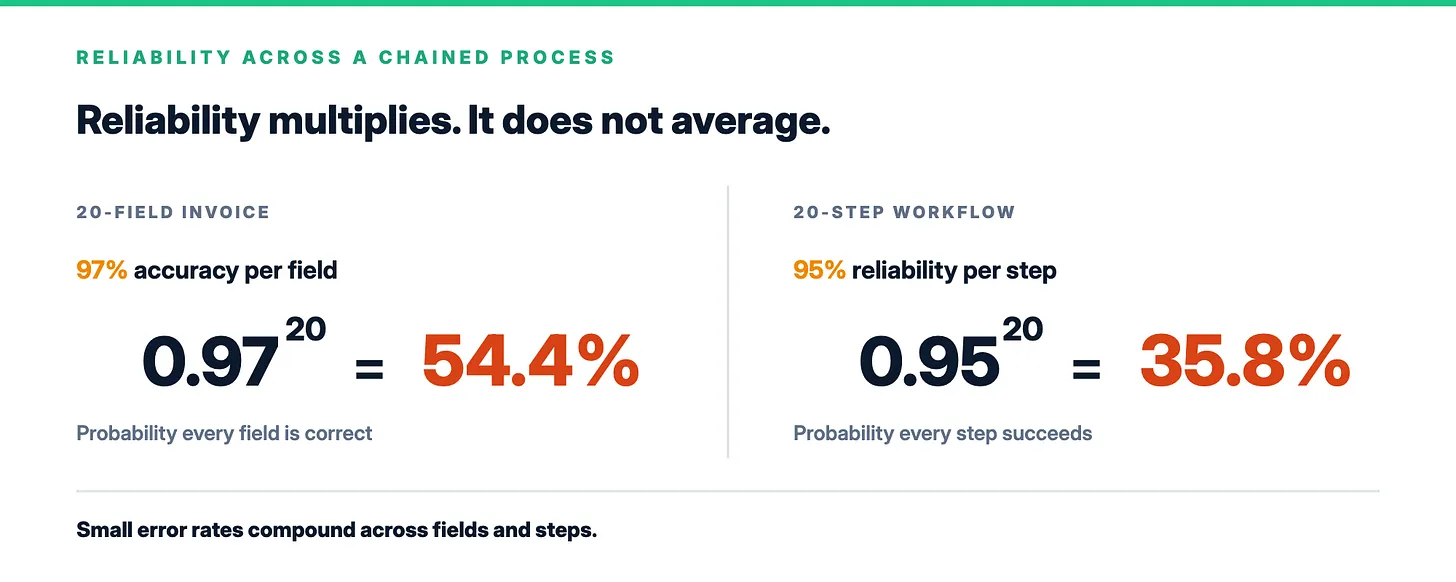
Illustrative calculations assume independent errors and constant reliability for each field or step.
Where each kind belongs.
Probabilistic AI is the right tool wherever judgment matters and a human or a downstream check is there to catch a miss. Reading a messy contract. Drafting variance commentary. Surfacing suspicious transactions for review. Summarizing a board pack. “Reasonable” is good enough, because someone reviews it.
Klarna demonstrated this honestly. They scaled their agent, then pulled part of it back once they saw that complex, emotionally charged customer conversations needed human judgment, not a model’s best guess. That was not a failure. It was a company finding its line and respecting it.
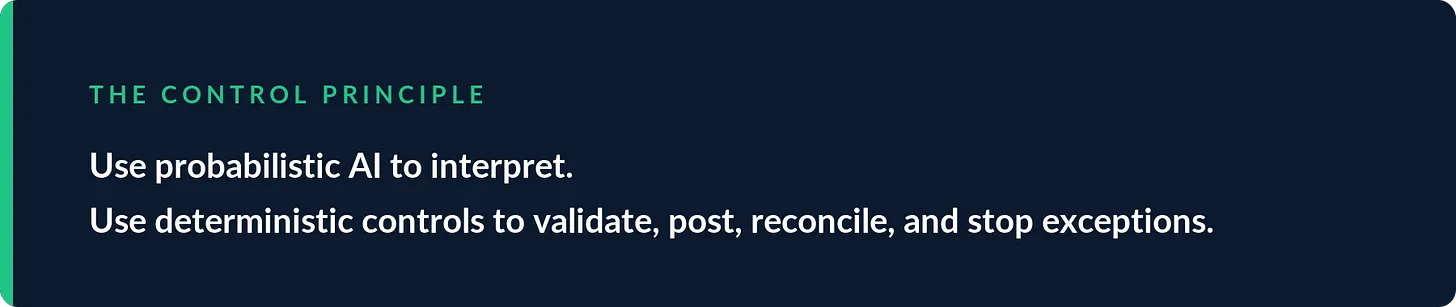
Deterministic execution is what you need wherever variance is unacceptable and the result must reconcile.
Reconciliations
Invoice posting
Payroll
Tax
Regulatory filings
KYC
The same transaction, run twice, must post to the same account for the same amount, not probably. It is telling that only 20 percent of leaders currently trust AI agents with financial transactions, and only 22 percent trust them with autonomous employee interactions. That instinct is correct. It is also exactly the work deterministic AI is built to take on safely.
Safer than what you already do.
Here is the reframe that matters most. “Safe” does not mean no automation. It means no surprises. Predictable, controllable, auditable. On all three, a well-scoped deterministic process beats the human status quo you currently consider safe.
The manual process you trust today runs on people keying figures late in the close, applying judgment inconsistently, carrying key-person risk, and leaving a partial trail. Humans have an error rate too. We simply never measured it. Deterministic automation replaces that with a process that is consistent by design, records every step, and reconciles on demand. You define the rules, the same controls your team already follows, and the system cannot step outside them. Anything it cannot resolve under those rules stops and escalates to a person rather than guessing. Every decision traces back to the rule that produced it and can be replayed for an auditor. That is a stronger position than “an experienced clerk handled it.”
It also answers the fear the headlines installed. The runaway-agent disasters you have read about, the deleted database, the airline chatbot that invented a refund policy a court then enforced, are all probabilistic systems handed autonomy with no hard boundary. Deterministic execution is the structural opposite. Bounded, rule-following, with no room to freelance.
The upside, and the cost of standing still.
None of this matters unless the upside is real. It is.
The value is not theoretical, and the figures above show it already at scale. When execution moves to a system that runs identically every time, three things change for a finance organization.
Cost stops scaling with volume. A manual process gets more expensive with every transaction, because more volume means more hours means more people. Deterministic execution breaks that link. You can double the invoices without doubling the team.
The close gets faster, and faster numbers are better numbers. A ten-day close that becomes a three-day close is not an efficiency metric. It is leadership seeing reality a week sooner, and acting on it a week sooner.
Your best people stop keying, matching, reconciling, and checking. Those are the same people you want on analysis and judgment, not stuck at their desks at 9pm during close. The drudgery is also why they leave.
Now the part most cost-benefit cases leave out.
The status quo is not free. It only looks free because the cost is already in the run rate and nobody itemizes it. Every month you do not automate a process that could be automated, you pay for it again. The manual hours. The overtime that arrives like clockwork every close. The rework when an error surfaces three steps downstream. The senior capacity you can never redeploy because it is tied up in work a machine could do.
And that cost compounds against you. The competitors automating their finance operations get cheaper and faster every cycle. Standing still is not holding position. It is falling behind at the rate everyone else improves.
The honest caveat is the one from earlier. These benefits are real only where the process is scoped correctly and the certain steps are genuinely deterministic. Automating the wrong step badly costs more than doing nothing. But leaving a process manual is itself a decision, and it carries a price you are already paying.
How to adopt it without betting the close on faith.
You do not have to take any of this on trust, and you should not.
Run the deterministic process in parallel with your team for a cycle or two.
Reconcile every output against what the people produced.
Require zero unexplained variance before anything cuts over.
If it cannot match your team on a controlled sample, it does not ship.
Once it clears that bar, measure the payback before you scale to the next process.
That turns “trust the AI” into “verify the AI,” which is how finance has always adopted anything. That discipline is not a weakness here. It is exactly the rigor this decision calls for.
The question in front of you was never whether AI can do the work. For almost any financial process, it can. The real question is narrower. Does the process in front of you need to be right, or only reasonable?
Most CFOs already know which of their processes have to be exact. The work is simply to go down the list, label them, and route the ones marked “must be exact” to a system that runs on fixed rules and returns the same result every time. That is what deterministic execution is built for.
Sources
Gartner, agentic AI project cancellations, June 2025.
S&P Global Market Intelligence, abandoned AI initiatives, October 2025.
PwC AI Agent Survey, trust in agents for financial transactions, May 2025.
Mayfield 2026 CXO AI Survey, agents deployed against agents in production, May 2026, via Trusys.
Digital Applied, the cost of a failed agent project, July 2026.
Klarna, the AI assistant's customer service workload, February 2024.
JPMorgan, AI use cases in production, May 2025, via Tearsheet.
Mastercard, generative AI in fraud detection, May 2024.
Zenity, the deleted production database, April 2026.