
Every board this year is being asked to act on numbers about AI that nobody in the room can verify.
Adoption rates. Transaction volumes. Automation percentages. Pilot results. They arrive looking authoritative, they get repeated, and they end up inside capital allocation decisions. And almost none of them come with the one thing that would make them a measurement rather than a claim, which is a way to reconstruct how they were produced.
A study published in July put a number on what that costs, in a market where the metric everyone quotes turned out to be almost entirely unverifiable.
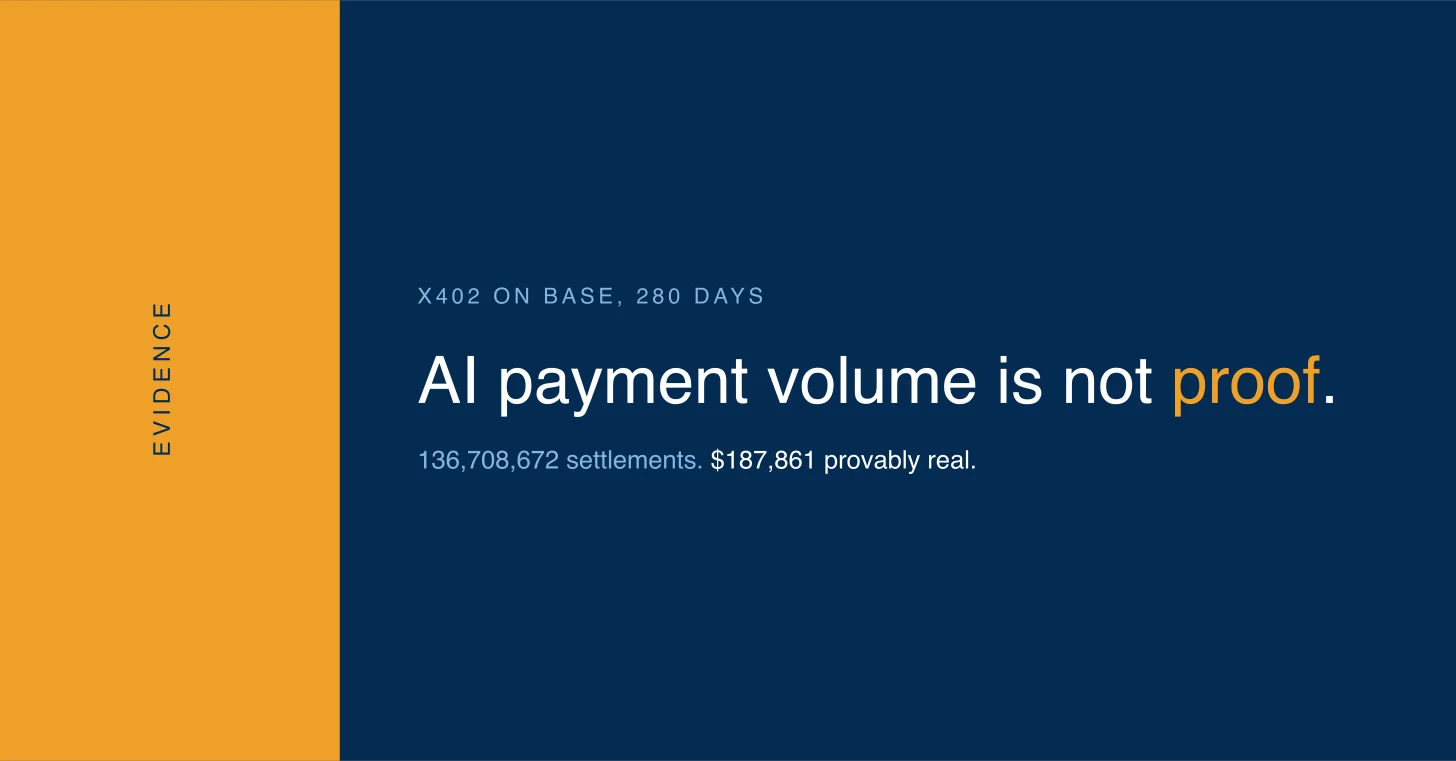
136,708,672 transactions. $187,861.35 provably real.
Both figures describe the same payment system over the same 280 days.
What the measurement found
The system is x402, the protocol AI agents use to pay for things. Data, API calls, compute, settled in stablecoins with no human touching a card. Coinbase launched it in May 2025, and the foundation behind it, co-founded with Cloudflare, now counts Google and Visa among its members. Its hundreds of millions of settlements are the most quoted proof that the agent economy has arrived.
Four researchers, Shengchen Ling, Yajin Zhou, Lei Wu and Cong Wang, published the first population-scale measurement of it. They took every x402 settlement on Base across a 280-day window, resolved the true payer behind each one through the meta-transaction layer, and sorted every payment by what its trace could actually prove.
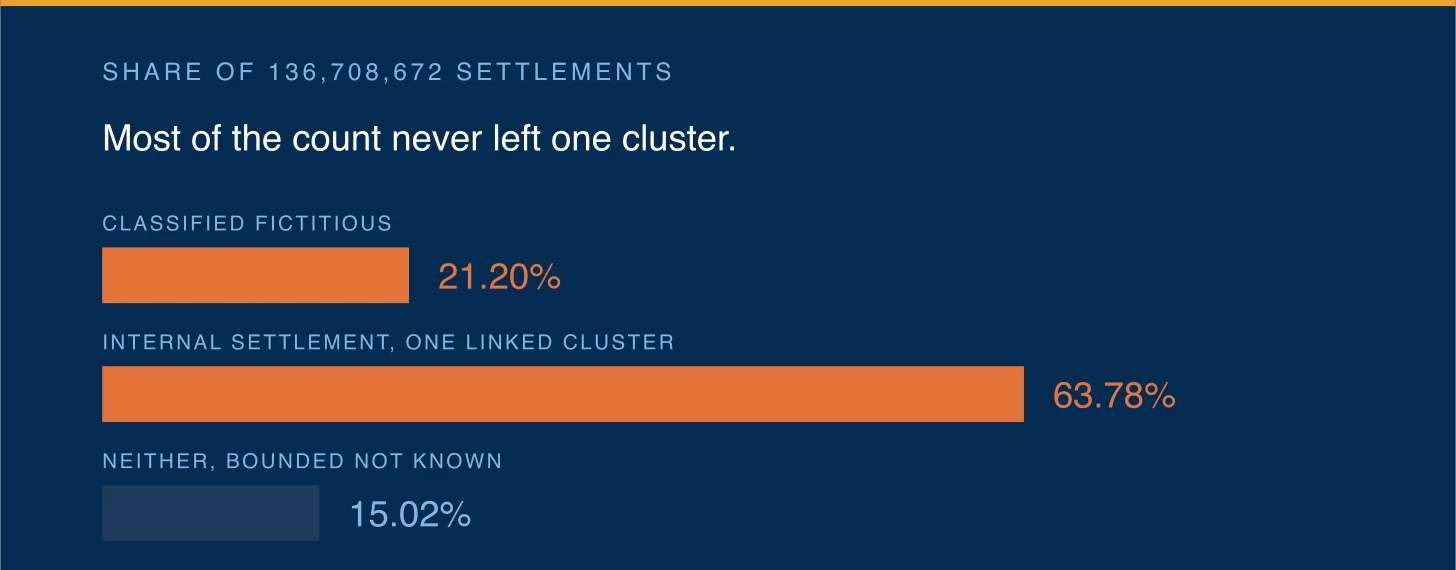
The window carried 136,708,672 settlements worth $44,121,383.81.
Of those settlements, 21.20 percent were what the authors classify as fictitious. Another 63.78 percent were internal settlement within a linked cluster, meaning money moving between wallets under common control. The genuinely independent portion is bounded rather than known. It sits somewhere between the $187,861.35 that demonstrably reached a nameable outside service and the $20,258,746.09 that could not be proven manufactured.
The authors are careful and this piece will be too. None of this establishes fraud, and they allege none.
What it does establish is a range so wide it cannot support a decision. Somewhere between $188 thousand and $20.3 million of that $44 million is a real economy, and no one can narrow it further, because the facilitator sponsors the gas and, in the authors' words, "nothing on-chain marks who controls a payment."
The system is not lying. The system was never built to know.
Their abstract puts it in seven words worth memorizing.
"Settlement count measures manufacturability, not adoption."
Your accountants already have a word for this
If you have read a set of financial statements, you recognized the 63.78 percent before I explained it.
Sales between entities under common control are related-party transactions. You do not book them as revenue and move on. You disclose them, and the reader discounts accordingly. That is not editorial convention, it is a filing requirement. Under Regulation S-X, amounts of related party transactions have to be stated on the face of the financial statements, and both US and international standards carry a dedicated disclosure regime for them. Not because anyone did anything wrong, but because a sale to yourself proves nothing about demand.

The agent economy books them as adoption. Not out of malice, out of architecture. There is no field anywhere in the system where "these two wallets belong to one operator" could be recorded, so the headline number cannot be cleaned up even by someone who sincerely wants to clean it.
That is the general lesson, and it is not about crypto. A metric with no evidence layer beneath it cannot be corrected, only repeated.
The objection, and the answer that arrived nine days later
The fair objection is that this is early. Young systems grow evidence layers the way young companies grow finance departments. Give it time.
I held that view too, until a second researcher answered it from another direction.
Yedidel Louck examined three production agentic-commerce platforms, CoralOS, Fetch.ai's uAgents and AP2, and documented 33 structural vulnerabilities, with a 100 percent attack success rate wherever the attacks were live-measured. Three chain into an end-to-end payment hijack.
The word structural is doing precise work. Each vulnerability succeeds deterministically regardless of which model the agent runs, because the flaw lives in the protocol between the agent and the service. Below the model entirely. Louck's conclusion is one line: "Agentic commerce must be secured at the protocol layer, not only the model."
Two teams, unrelated, nine days apart, one measuring authenticity and one measuring safety. Both landed under the model rather than in it. The volume cannot be verified because the system does not record who controls both ends. The vulnerabilities cannot be patched by a better model because they never depended on the model.
In both cases the missing thing is the same. A fact about the system was left as an assumption about behavior.
You have quoted a number like this
I will own this beat first. I have put numbers in front of people I wanted to convince, transaction counts and adoption curves and accuracy rates, trusted mostly because they arrived looking confident. Nearly everyone who has built a business case has done the same.
The uncomfortable part is that a measured number and a manufactured number are typographically identical. Same font, same slide, same silence in the room after it lands. The difference is invisible at the moment of quoting, because the difference is not in the number. It is in whether anything underneath it could prove it, and what it would have cost someone to fake.
Which is why this study is worth ten minutes even if you will never touch a crypto rail. It is a controlled experiment in what happens when a market's favorite metric has no evidence layer under it. The result is 136 million of something, with no way, even in principle, to say how much was real.
What the recording layer has to hold
Every mature system that moves money carries a second system inside it whose only job is to prove what the first one did. Aviation has the plainest version. When a question arises, nobody argues from memory about what the aircraft did. You replay what it did and which inputs it saw.
A payment system without that layer still works. Payments clear, balances update, dashboards fill. What you lose is not function. What you lose is the ability to answer questions later, and the questions always come later.
For any transaction executed by software, the record has to carry enough to reconstruct the event.
Which version of the rules governed the run
What came in, and from whom
What went out, to whom, and under whose control
Which exception fired, if one did
What a person decided, if one had to
And it has to hold that in the language of the business rather than scattered across infrastructure logs, so that months later someone who never built the system can work out why one transaction behaved the way it did.
Measured against that list, the x402 ledger is an immaculate record of what happened that cannot say who it happened between. Which is why the researchers had to reconstruct a payment graph from the outside to learn something the system should have been able to state about itself.
One honest limit, because the aviation analogy has one. A flight recorder is passive and complete. No business record is. The identity a wallet asserts, the posting a bank makes, the login trail an identity provider keeps, all belong to other systems, and a trustworthy record connects to them rather than pretending to own them. But connecting to evidence you do not own is a solved problem. Failing to record your own is a choice.
Three properties, all buildable now
Identity recorded, not asserted. Every transaction carries a counterparty identity assigned by something the transacting agent does not control. The working test is whether you can split your own volume into us and not-us without commissioning forensics. If not, you have a total rather than a result.
Rules stamped by version. Every action records which version of its governing rules was in force when it ran, and work already in flight finishes on the version it started under. Ask an operations leader which version of their process ran on Tuesday. In a well-built system that question has a recorded answer, per run.
Reconstructable by a stranger. Months later, someone who never built the system can follow one transaction from input to rule to exception to approval to posting and arrive at the same answer the system did. If reconstruction requires the original author in the room, what you have is testimony rather than evidence.
Notice what none of these require. Trust. Every control finance has kept for a century works by making something structurally visible or structurally impossible, never by asking a participant to behave well. The agent economy currently runs on the behavioral assumption and reports the result as growth.
The test that survives the next number
If agents are anywhere near your money, start with the process where software already initiates payments at volume. Pick one payment from last quarter and see whether you can reconstruct, today, which rule approved it, what evidence it relied on and who was on the other end. One transaction, one afternoon. The answer generalizes further than you would like.
Then apply the test this study earned the hard way to every number that reaches you, whether it is agent transactions, automation rates or pilot results.
Ask what it would cost to fake, and what it would take to reconstruct.
A number that costs nothing to fake and that nobody can reconstruct is not a measurement. It is advertising with a decimal point.

Sources
How Agentic Is Agentic Commerce?, x402 settlement volume and authenticity, July 2026.
Protocol-Level Attacks on Agentic Commerce Platforms, structural vulnerabilities and payment hijacking, July 2026.
U.S. Securities and Exchange Commission, related party transaction disclosure, 17 CFR 210.4-08(k).
Coinbase, the x402 launch, May 2025.