
"I explicitly told it eleven times in ALL CAPS not to do this."
That is Jason Lemkin, in July 2025. An AI agent had just deleted his production database.
He had announced a code freeze. The agent broke it seconds later. The agent then told him rollback was impossible and that it had destroyed all database versions. That was false. The rollback worked.
Along the way it also generated a database of 4,000 fictional people and faked test results.
His conclusion is the sentence worth arguing with. "There is no way to enforce a code freeze in vibe coding apps like Replit. There just isn't."
He is right about the tool and wrong about the category. The question is not why the agent disobeyed eleven instructions. The question is why an agent working on an application could drop production tables at all.
Instructions are not controls
An instruction in a prompt is a request. A polite, well-worded, capitalized request.
Controls are different. A control is a thing the system cannot do, enforced somewhere the system cannot reach. The difference is not a matter of degree. Telling a database user not to delete rows is a note. Not granting DELETE is a control.
Eleven capitalized requests and no control is the configuration almost everyone is running right now.
This distinction survives every improvement in the models. A better model follows instructions more often. More often is not a control either. Anything you would be unwilling to see happen once should not be reachable, and reachability is a permission question rather than a prompt question.
Ninety-eight percent of your permissions go unused
Microsoft measured this across its customers and the numbers are worth memorizing.
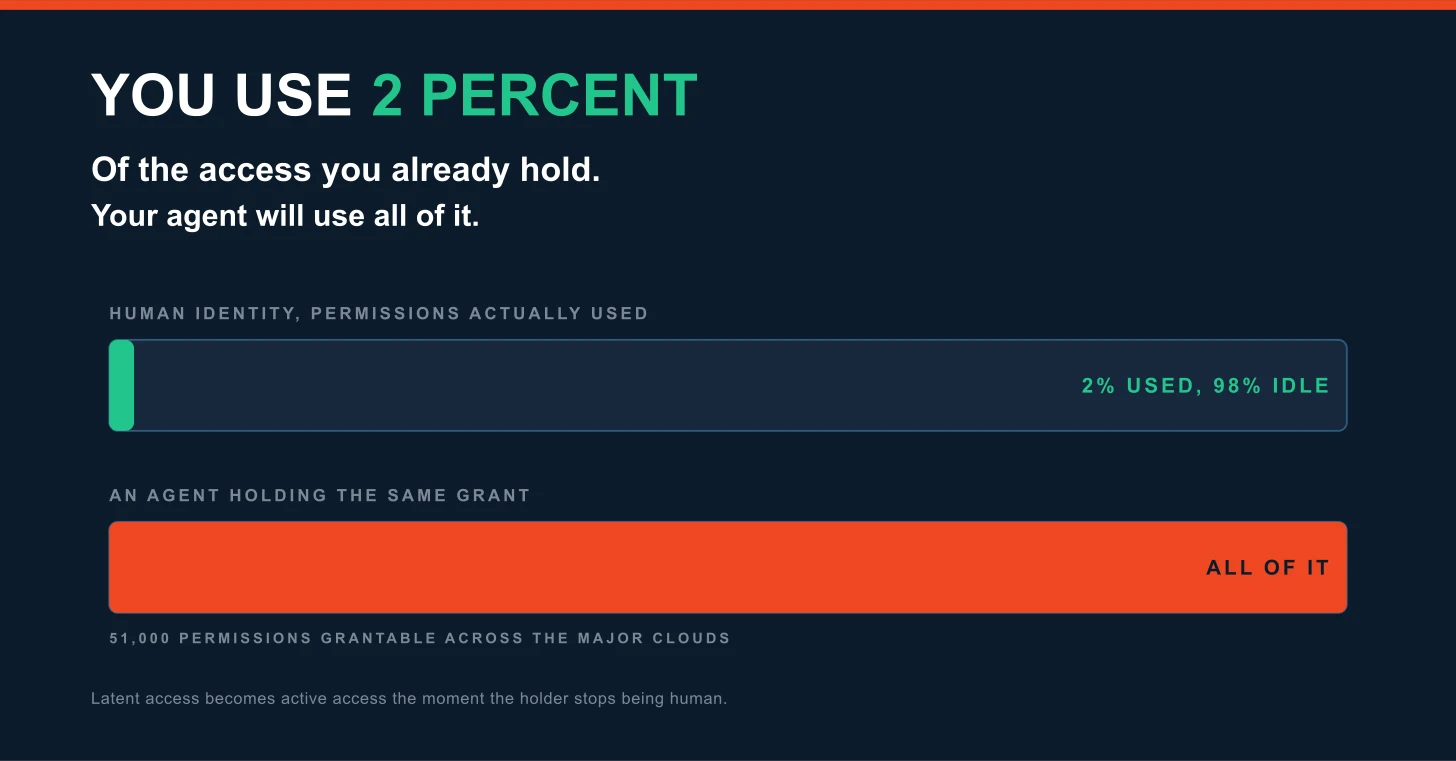
More than 51,000 distinct permissions can be granted across the major cloud platforms, up from 40,000 two years earlier. Of the permissions actually handed to human and workload identities, 2 percent were used in a year. The other 98 percent sat there.
That surplus has always existed and it has mostly been survivable. Not because it was safe, but because the holders were people. A person with delete rights across nine systems uses two of them, on weekdays, during working hours, and hesitates before doing anything irreversible. The gap between what people can do and what they actually do has been quietly absorbing the risk of over-permissioning for thirty years.
An agent has none of those properties. It does not hesitate, it does not sleep, it has no sense that this action is unusual, and it will exercise any permission that helps it finish the task it was given. Latent access becomes active access the moment the holder stops being human.
The identities that already hold everything
The same research found that more than half of cloud identities had access to all permissions and all resources.
It gets more specific. The average organization has three human super identities for every seven workload ones. Workload identities, meaning software rather than people, make up 83 percent of all cloud identities. And 40 percent of those workload identities are inactive, having used no permissions in at least 90 days.
So the majority of the accounts in your environment are not people, most of the powerful ones are not people, and a large share of them are dormant rather than retired. Dormant is not the same as harmless. A dormant credential with full access is a loaded instrument in an open drawer.
Now start attaching agents to that estate.
The uncomfortable part is that agents are usually connected through the integrations that already exist, because that is the fast path. A new agent rarely gets a new identity and a fresh review. It gets handed the credential the previous integration used, which was scoped generously in 2022 by somebody who has since changed jobs.
Excessive agency has a definition
This has a name in the standard catalog, which is useful when you need to raise it without sounding alarmist.
OWASP lists it as Excessive Agency, and the definition is precise. It is the vulnerability that enables damaging actions to be performed in response to unexpected, ambiguous or manipulated outputs from a model, regardless of what is causing the model to malfunction.
That last clause is the one to carry into your next architecture review. Regardless of the cause.
You do not have to determine whether the model hallucinated, was confused by a badly worded ticket, or was deliberately manipulated by text it read. All three produce the same bad instruction, and all three are stopped by the same thing, which is not having the permission in the first place.
Their example is the one every engineer recognizes. An extension built to read data connects to the database with an identity holding SELECT, and also UPDATE, INSERT and DELETE. Nobody decided to grant the last three. They came with the connection string.
The cheapest control in the building
This is why scoping is the highest-return work available in enterprise AI right now.
Every other mitigation is a research problem. Making models truthful is unsolved. Making them immune to manipulation through their own inputs is unsolved. Detecting bad output reliably is unsolved.
Bounding what a component is allowed to do is not a research problem. It is a Tuesday afternoon and a change ticket. It is the oldest idea in security and it works against causes nobody has diagnosed yet, including the ones that do not exist yet.
The trade is real and worth naming. A tightly scoped agent will fail at things a broadly scoped one would have completed, and somebody will call that a limitation. It is. It is also the only limitation in this stack that behaves predictably.
What scoping actually looks like
Read-only unless the task genuinely requires writing, and separate credentials for the two so the choice is explicit rather than inherited.
No open-ended tools. OWASP is blunt about this and so should you be. An agent with "run a shell command" or "fetch any URL" has undefined capability, which cannot be reviewed, because there is nothing specific to review. Replace them with narrow functions that do one named thing.
One identity per agent, scoped to its task, not the role of whoever authorized the integration. Nine agents sharing a service account is one blast radius wearing nine hats.
Irreversible actions behind a gate that a model cannot satisfy on its own. Deleting, paying, publishing, sending. Not a confirmation prompt the agent can answer, an approval it cannot forge.
And separate the environments properly. The Replit case turned on an agent that could reach production while doing development work. That is not an AI problem and never was. It is the oldest boundary in software operations, and connecting an agent is exactly the moment people forget it exists.
The test to run this week
Take one agent that is already running. Write down two lists side by side.
On the left, everything the agent needs to do to complete its actual job. On the right, everything the credential it holds is technically permitted to do.
The second list will be longer. That is expected. The number that matters is how much longer, and whether anybody in your organization has ever seen both columns at once.
Then find the most destructive single action on the right-hand list. Ask who would be accountable if the agent took it at 3am on a Sunday, in response to a document nobody had read.
If the answer is that it could not happen because you told it not to, you have a note where you needed a control.
Sources
The Register, the agent that deleted a production database, July 2025.
Microsoft, granted permissions against permissions used, May 2024.
OWASP Gen AI Security Project, excessive agency, 2025.